Gold · Yearly Review
The International Gold Market in 2025
Federal Reserve Monetary Policy
In 2025, the Federal Reserve shifted toward a monetary easing cycle amid deteriorating labor market conditions and slowing economic activity, even as inflation remained above its 2% target. Despite occasional quarterly spikes (e.g., +4.3% in Q3), full-year growth was expected to come in well below 2024's pace — roughly 1.5–2.0%, against 2.8% growth the year prior.
As of September, annual CPI growth stood at around 3.0%, above both the Fed's target and September 2024's reading of 2.4%. Core PCE ran at 2.8–2.9% year-over-year, versus roughly 2.7% a year earlier — signaling persistent inflationary pressure that limited room for more aggressive easing.
The key driver of the policy shift was a weakening labor market. U.S. unemployment rose to roughly 4.4% in September, up from about 4.1% a year earlier — one of the highest readings since 2021. That rise came alongside modest job growth (~119,000 new jobs), pointing to a cooling labor market and raising concerns about broader economic softening under high real interest rates. New York Fed President John Williams stressed in his remarks that further Fed decisions needed to weigh the "balance of risks" between inflation and employment — signaling no need for hasty moves, while acknowledging that labor-market weakness called for a more flexible approach to rates.
Treasury yields remained an additional source of volatility for gold prices. Despite expectations of Fed easing, 10-year Treasury yields repeatedly approached levels above 4%, holding near three-month highs of roughly 4.16–4.20% — a headwind for gold, since higher nominal and real rates raise the opportunity cost of holding a non-yielding asset.
Against this backdrop, the Fed began easing in the second half of the year. After an extended period holding rates at restrictive levels, the federal funds target range was cut to 3.50–3.75% by September–December — a cumulative reduction of about 75 basis points from the end-2024 level of 4.25–4.50%. Fed Chair Jerome Powell noted publicly that the central bank had "already cut rates by roughly 75 bps since September" and that policy had moved close to neutral-rate estimates, while stressing that the path ahead would depend on incoming inflation and labor data. Governor Christopher Waller, however, noted the Fed remained roughly 50–100 bps above the neutral rate. Other Board members took a more cautious tone — Governor Lisa Cook signaled that further easing, including a possible December cut, was not a foregone conclusion and should rest on an objective assessment of inflation and employment risks rather than automatically following market expectations, emphasizing a patient approach amid considerable economic uncertainty.
U.S. Tariff Policy
U.S. protectionist trade policy was a major source of financial-market uncertainty in 2025, fueling elevated demand for gold as a safe-haven asset. In March, the U.S. government announced a new wave of tariffs on imported vehicles and other goods, intensifying fears of a broader global trade war. In response, gold prices repeatedly set new records — by early April, spot gold had climbed to roughly $3,150–3,170/oz, a gain of more than $500/oz since the start of the year, as the dollar weakened amid growing doubts about the reliability of the global trading system.
By mid-summer, following another round of tariffs, gold continued to show strong safe-haven demand — spot gold rose to roughly $3,356/oz in July, gaining more than 1% in individual sessions, reflecting the market's reaction to rising trade barriers alongside growing expectations of Fed easing.
Gold's rally continued as trade risks persisted and policy expectations evolved further. By December, spot gold reached an all-time high of roughly $4,383/oz — a gain of more than 67% for the year — driven not only by rate-cut expectations but also by a broader reallocation of capital into safe-haven assets amid trade and geopolitical uncertainty.
At the same time, periods of easing trade tension produced technical corrections. In late October, on signs of a possible thaw in U.S.–China trade relations, spot gold briefly fell below $4,000/oz, losing roughly 3–3.2% from recent highs (a pullback from the $4,120–4,140/oz range) — a clear illustration of the precious metals market's sensitivity to shifting trade-risk expectations.
Global Gold Demand
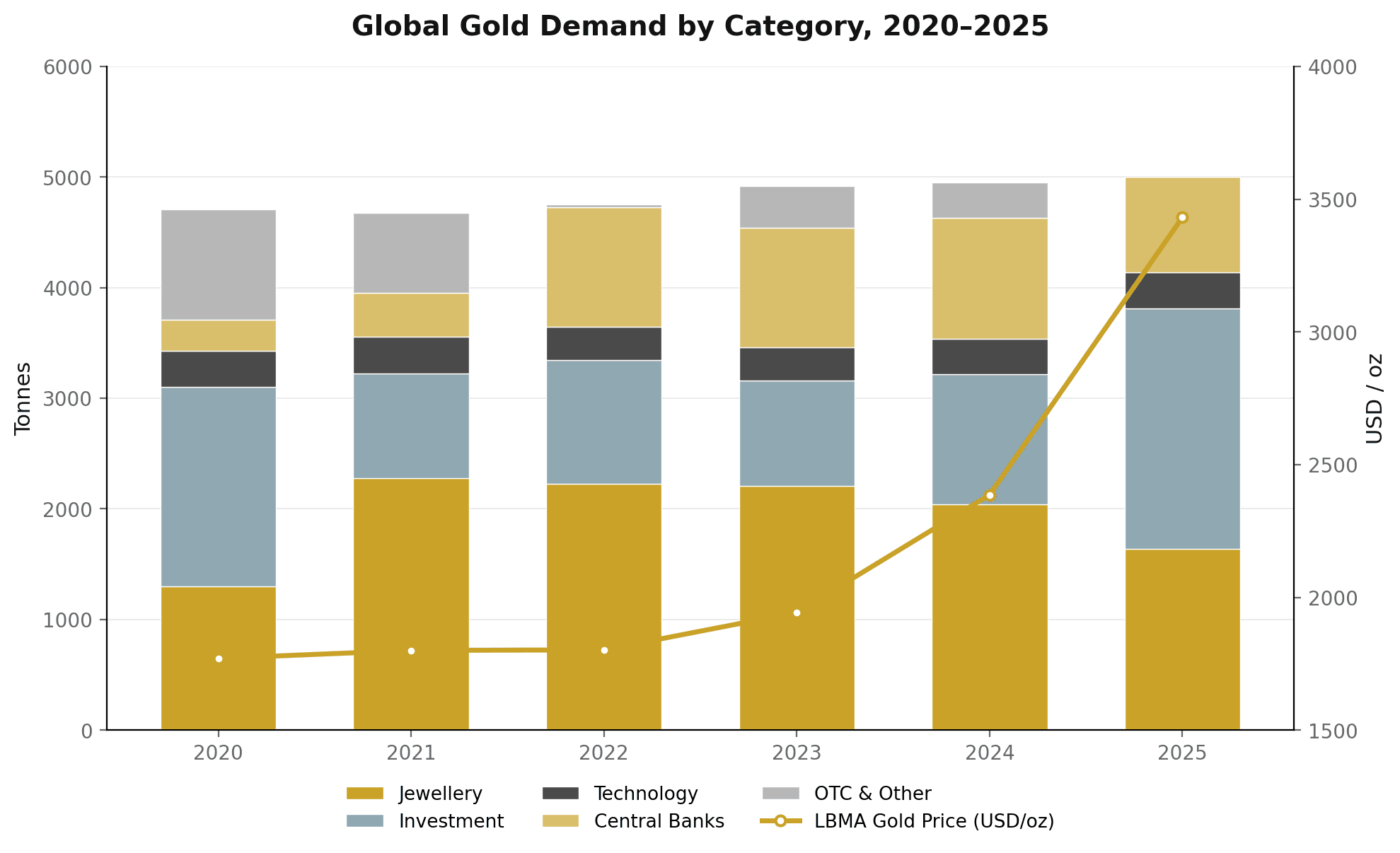
Global gold demand rose from 4,961.9 tonnes in 2024 to 5,002.3 tonnes in 2025, an increase of roughly 1%. The main driver was investment demand, which surged 84% — from 1,185.4 to 2,175.3 tonnes. Meanwhile, jewelry demand fell from 2,026.6 to 1,638 tonnes, technology-sector demand slipped from 326.2 to 322.8 tonnes, and central bank demand declined from 1,092.4 to 863.3 tonnes. The average annual gold price per LBMA data rose from $2,386.2/oz in 2024 to $3,431.5/oz in 2025.
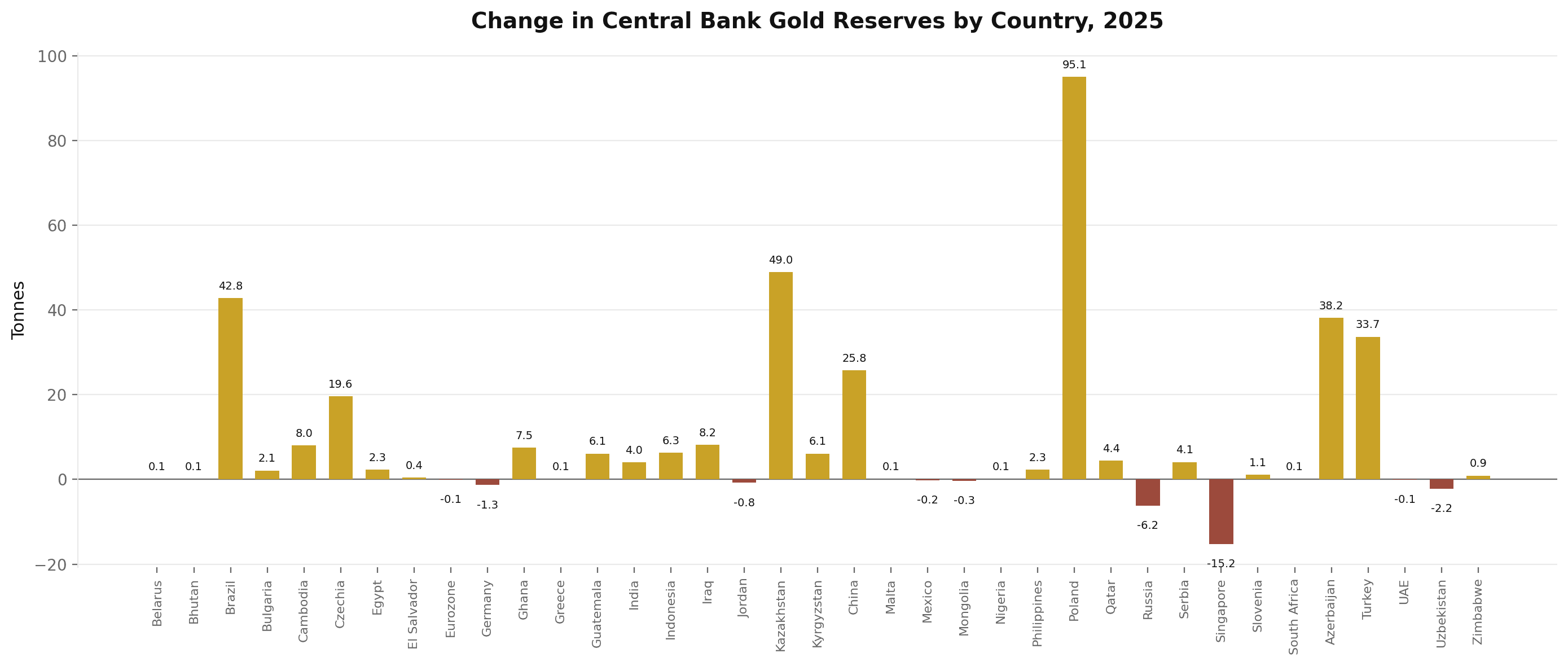
Even with an overall decline in official-sector demand compared with the prior year, several central banks continued adding to gold reserves. Net reserve additions across the year totaled 342 tonnes, with the largest increases from Poland (95.1t), Kazakhstan (49t), Brazil (42.8t), Azerbaijan (38.2t), Turkey (33.7t), and China (25.8t).
Global Gold Supply
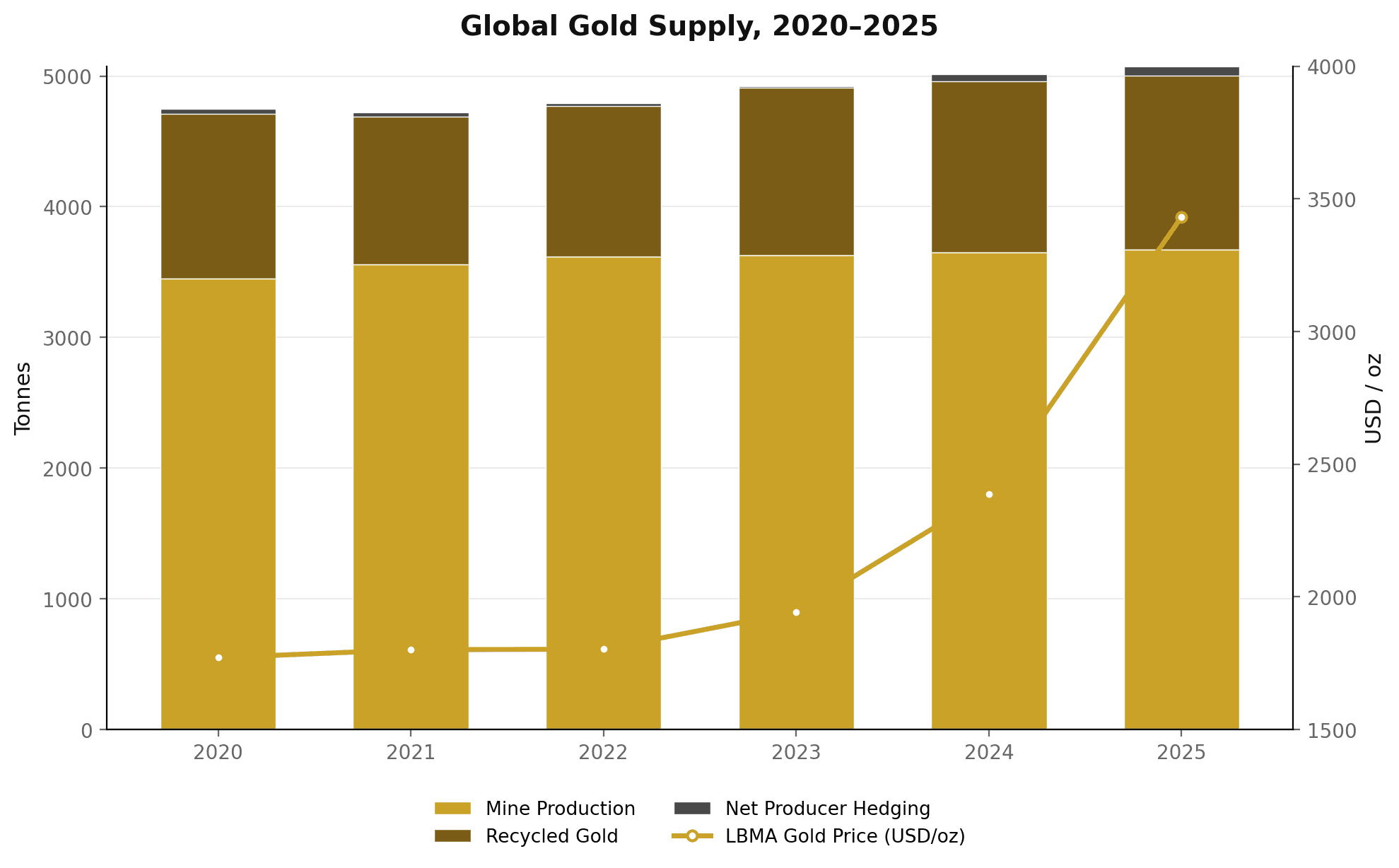
Gold supply rose in step with demand in 2025. Total mine production increased from 3,650.4 to 3,671.6 tonnes, while recycled gold volume rose from 1,365.3 to 1,404.3 tonnes. Net producer hedging, however, declined by 19.8 tonnes, moving from -53.8 to -73.8.
Sources
- London Bullion Market Association (LBMA) — annual average gold price data
- World Gold Council — Gold Demand Trends, full-year 2025
- Federal Reserve — FOMC statements and public remarks, 2025
- U.S. Bureau of Labor Statistics — CPI and employment data, 2025
This article is provided for informational purposes only and does not constitute investment, financial, or trading advice.