Gold · Gold Education
"If It Can Be Frozen With a Keystroke, It's Not Really Yours": Why Central Banks Are Buying Gold Again
The Moment That Changed Everything
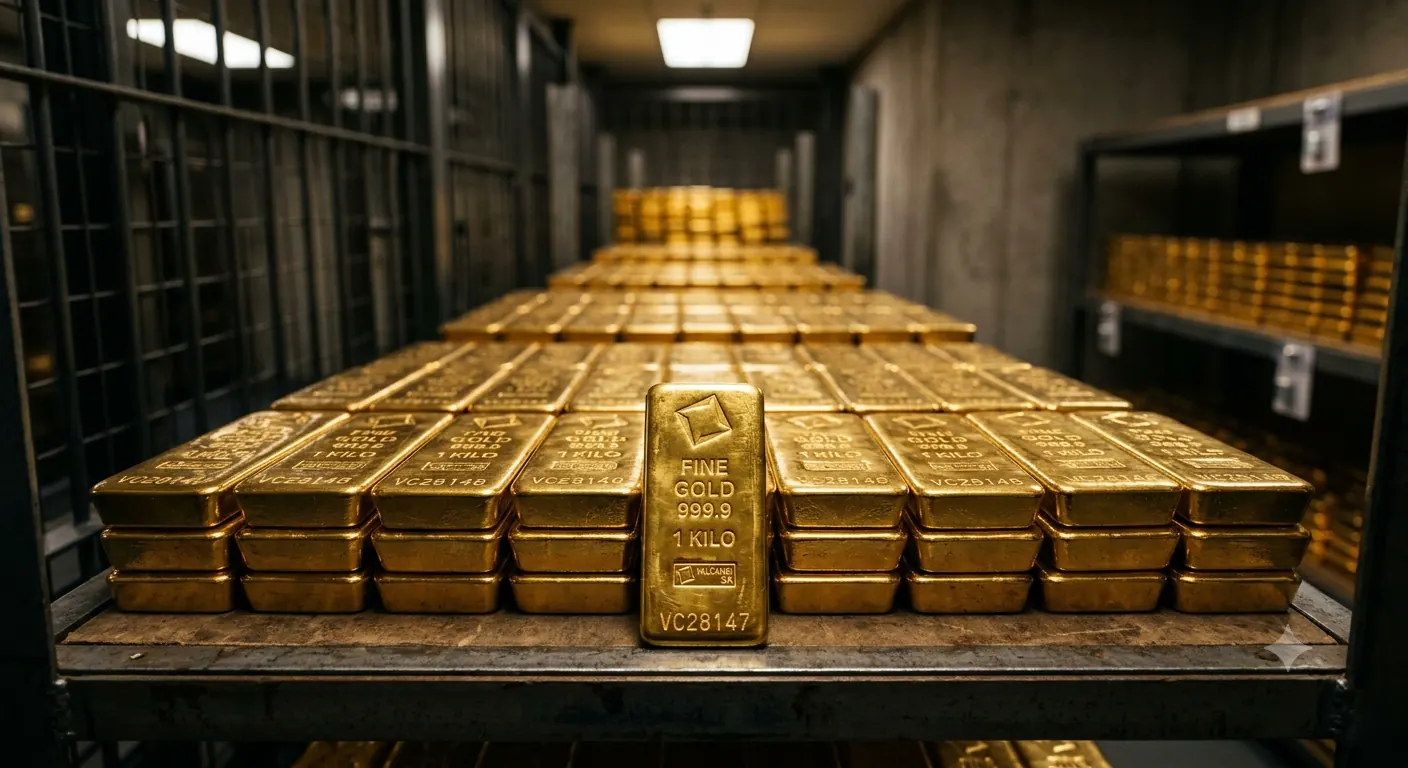
In February 2022, the United States and its allies froze roughly half of Russia's foreign currency reserves — hundreds of billions of dollars, seized not by a court, not by a negotiation, but by a coordinated decision executed almost overnight. For decades, holding dollars and euros had been the default, unquestioned way for a central bank to store national wealth. Overnight, every other country watching realized something uncomfortable: those reserves can be switched off.
Gold can't be frozen the same way. It has no counterparty, no issuer, no foreign government that can flag an account. An ounce of gold sitting in a country's own vault answers to nobody. That distinction, which had been a minor academic footnote for most of the post-war financial era, suddenly became the single most important property an asset could have — and central banks responded exactly as you'd expect an institution to respond to a wake-up call about its own vulnerability. They started buying gold, in quantities the market had not seen in generations.
Key Takeaways
Central banks were net sellers of gold through most of the 1990s and 2000s — mainly European nations offloading reserves under a formal agreement. That trend reversed around 2008–2010 and has never gone back.
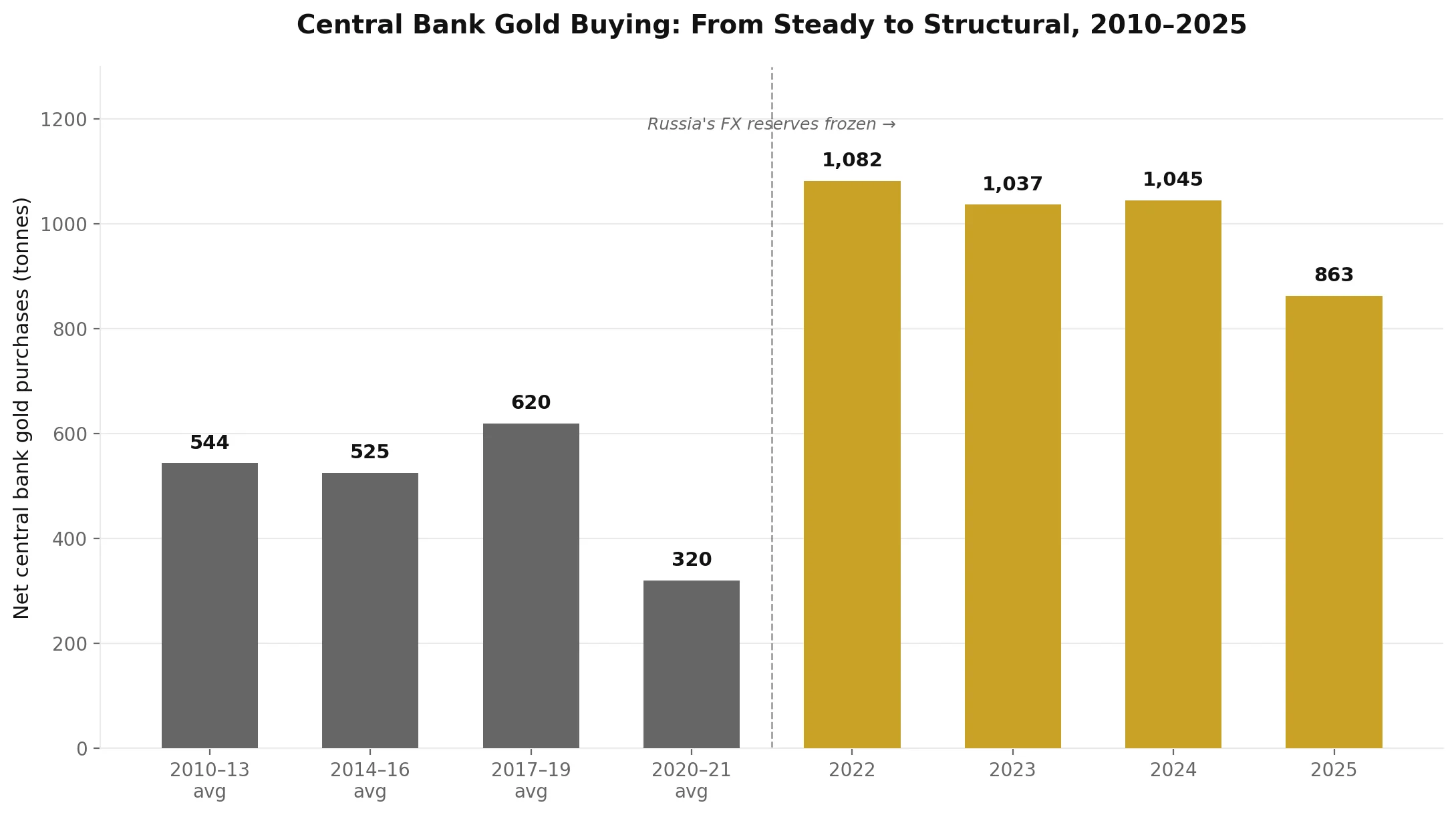
Buying has run at over 1,000 tonnes a year in 2022, 2023, and 2024 — roughly double the 2010–2021 average of about 473 tonnes a year.
The clearest catalyst was Russia's frozen FX reserves in 2022, which pushed emerging-market central banks toward gold as a reserve asset with no counterparty risk.
This buying is price-insensitive and structural — unlike ETF or speculative demand, central banks don't sell into a rally or panic-sell into a dip, which is part of why analysts describe it as raising gold's long-term price floor.
The trend isn't uniform: Russia itself became a net seller after 2022, and buying slowed sharply in early 2026, a reminder this is a strong trend, not an unstoppable one.
From Net Sellers to Record Buyers
It's easy to assume central banks have always hoarded gold. For roughly two decades, the opposite was true. Between 1999 and 2021, a group of mostly Western European central banks — Switzerland, France, the Netherlands, the United Kingdom — operated under a series of formal agreements (the Central Bank Gold Agreements) that coordinated their gold sales, treating bullion as a legacy asset to gradually offload in favor of interest-bearing currency reserves. Through the 1990s and early 2000s, central banks as a group were consistent net sellers.
That began reversing around 2008–2010, in the aftermath of the global financial crisis, as confidence in the banking system and fiat currency management took a genuine hit. The shift was gradual at first — the 2010–13 period averaged around 544 tonnes of net annual buying, dipping to roughly 320 tonnes a year during 2020–21 as the pandemic disrupted normal reserve management. Then 2022 happened, and net purchases roughly tripled in a single year to over 1,000 tonnes — a level that has now held for three consecutive years running.
Why Central Banks Actually Buy Gold
The 2022 reserve freeze is the clearest single catalyst, but it activated motivations that were already building. Three reasons show up consistently in central banks' own stated rationale and in analysis of their buying patterns:
Counterparty risk. Every dollar or euro a central bank holds is, technically, a liability of another government or institution — it can be frozen, sanctioned, or subjected to capital controls. Gold, held domestically, carries none of that risk. This is the lesson Russia's 2022 experience taught the rest of the world in the most direct way possible.
De-dollarization. A growing number of emerging-market central banks have explicitly stated a goal of reducing reliance on the U.S. dollar as their primary reserve currency, both to reduce single-currency concentration risk and, for some, as a geopolitical hedge against U.S. monetary and foreign policy.
Inflation and currency hedging. Gold has no central bank that can print more of it, making it a natural hedge against domestic currency devaluation — a particularly relevant concern for countries that have experienced high inflation or currency instability themselves.
Who's Actually Buying — and the One Big Exception
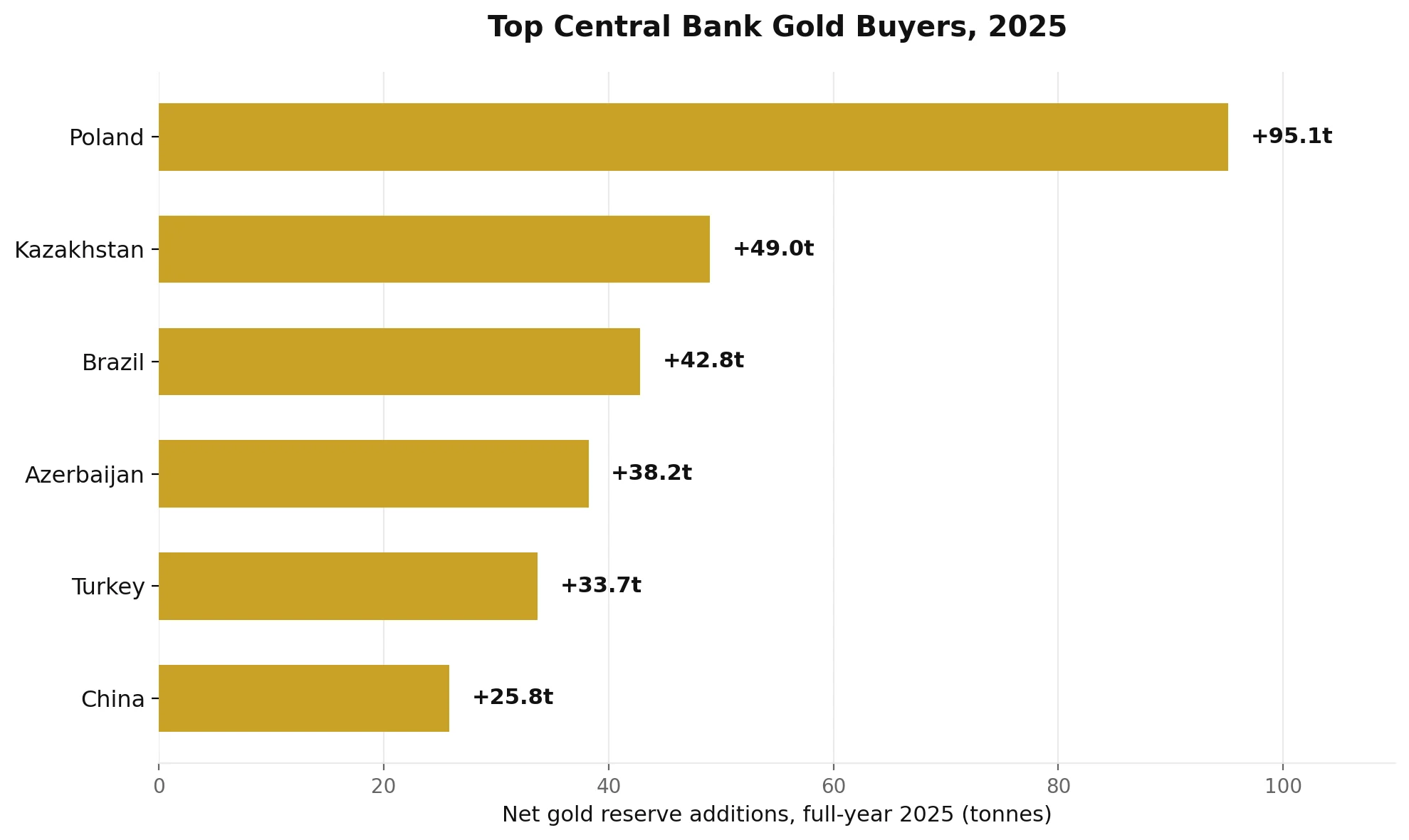
The buying isn't evenly distributed. In 2025, Poland was the single largest buyer, adding roughly 95 tonnes to its reserves, followed by Kazakhstan (49 tonnes), Brazil (43 tonnes), Azerbaijan (38 tonnes), Turkey (34 tonnes), and China (26 tonnes). China's pace is notable less for any single year and more for its consistency — the People's Bank of China has reported gold purchases in the large majority of months since late 2022, building its reserves toward roughly 10% of total holdings.
The most counterintuitive story, though, belongs to Russia. Russia and China were the two largest gold buyers of the two decades before 2022, with Russia accelerating sharply after Western sanctions first hit in 2014 following the annexation of Crimea. But after the far more severe 2022 sanctions and reserve freeze, Russia's own buying essentially stopped — and by January 2026, Russia had become a net seller, offloading roughly 9 tonnes that month and pushing its holdings to a four-year low. The country that arguably did the most to demonstrate gold's appeal to everyone else has, since then, been drawing its own reserves down, likely reflecting the practical financial pressures of a sanctioned economy rather than any change of view on gold itself.
It's also not unusual for individual central banks to swing between buying and selling in any given year — Kazakhstan, for instance, is a significant domestic gold producer and has alternated between adding to and drawing down reserves depending on market conditions and government financing needs in different years.
Why This Matters for the Gold Price
Central bank demand behaves differently from almost every other source of gold demand, and that difference is what makes it significant for price. ETF investors and speculative traders tend to buy into rallies and sell into declines — demand that amplifies price swings in both directions. Central banks do close to the opposite: they buy steadily, hold for the long term, and generally aren't managing a trading position they need to exit on a bad week.
This is why analysts describe the post-2022 buying wave as having effectively raised gold's structural price floor rather than simply adding to short-term momentum. It's also the specific mechanism behind one of the more surprising episodes covered in this site's guide to gold and Fed policy: gold's failure to fall as expected during the 2022–2023 rate-hiking cycle, even as real interest rates rose sharply. Central bank buying was the demand that didn't care what real yields were doing — and it's the same buying described in this article.
Is This Trend Guaranteed to Continue?
No, and recent data is a useful reality check against treating this as a one-way bet. Full-year 2025 net purchases came in around 863 tonnes — still historically high, but below the 1,000-plus tonne pace of 2022–2024. January 2026 data showed a sharper slowdown still, with net purchases across all central banks totaling just 5 tonnes for the month, a fraction of the pace seen at the peak of the buying wave.
One month, or even one year, of slower buying doesn't undo a structural shift built on genuine, stated reserve-management concerns. But it's a reminder that this is a strong and well-documented trend, not a law of physics — central bank buying can and does fluctuate with gold's price level, individual countries' financing needs, and how urgently any given government currently feels about reserve diversification.
Frequently Asked Questions
Why did central banks suddenly start buying so much gold in 2022? The U.S. and its allies freezing a large portion of Russia's foreign currency reserves in February 2022 demonstrated that dollar and euro reserves carry real counterparty and sanctions risk. Many emerging-market central banks responded by accelerating gold purchases, which carry no equivalent risk.
Which countries are buying the most gold? In 2025, Poland, Kazakhstan, Brazil, Azerbaijan, Turkey, and China were the largest buyers. China has been notable for the consistency of its buying, with purchases reported in most months since late 2022.
Has any major central bank been selling gold? Yes — Russia, historically one of the largest buyers, became a net seller by January 2026, likely due to the financial pressures of operating a sanctioned economy. Some smaller central banks that also produce gold domestically, like Kazakhstan, alternate between buying and selling from year to year.
Does central bank buying guarantee gold prices will keep rising? No. It's one significant, well-documented source of demand that behaves differently from investment or speculative demand, but gold prices are also driven by real interest rates, the dollar, and broader risk sentiment, as covered in this site's guide to gold and Fed policy.
Where can I check this data myself? The World Gold Council (gold.org/goldhub) publishes quarterly Gold Demand Trends reports with country-level central bank purchase data, updated regularly and free to access.
Key Conclusions
Central banks were net sellers of gold for most of the 1990s and 2000s, reversing to net buyers around 2008–2010.
Net purchases have exceeded 1,000 tonnes annually in 2022, 2023, and 2024 — roughly double the 2010–2021 average.
The clearest catalyst was Russia's 2022 reserve freeze, which highlighted counterparty and sanctions risk in traditional dollar and euro reserves.
Poland, Kazakhstan, Brazil, Azerbaijan, Turkey, and China were 2025's largest buyers; Russia itself became a net seller by January 2026.
This buying is structurally different from investment demand — steady and price-insensitive — which is why it's credited with raising gold's long-term price floor rather than just adding short-term momentum.
The pace slowed notably in late 2025 and early 2026, a reminder this is a strong trend worth monitoring, not a permanent guarantee.
Sources
- World Gold Council — Gold Demand Trends, quarterly central bank purchase data, 2022–2025
- World Gold Council — Central Bank Gold Reserves Survey
- World Economic Forum — "Here's how central banks have used gold in the last 30 years"
- Visual Capitalist / BullionVault — "A Decade of Central Bank Gold Purchases"
- Advantage Gold — country-level central bank gold buying analysis, 2025–2026
This article is provided for informational purposes only and does not constitute investment, financial, or trading advice.