Gold · Gold Education
Gold vs. Bitcoin: Does "Digital Gold" Actually Behave Like Gold?

Two Assets, Same Ten Months, Very Different Outcomes
In October 2025, Bitcoin hit an all-time high of $126,198. For over a decade, its backers had marketed it as "digital gold" — a scarce, portable, inflation-proof alternative to the metal itself. Ten months later, by August 2026, Bitcoin had fallen roughly 50%, trading near $64,000. Gold, over that same stretch, was essentially back where it started — after setting its own record high of $5,589/oz in January 2026 along the way.
Two assets, both pitched as scarce stores of value, given the same ten months. One lost half its worth. The other barely moved. If "digital gold" is supposed to behave like gold, something in that story doesn't add up — and the gap between the pitch and the data is worth understanding before you treat the two as interchangeable.
Key Takeaways
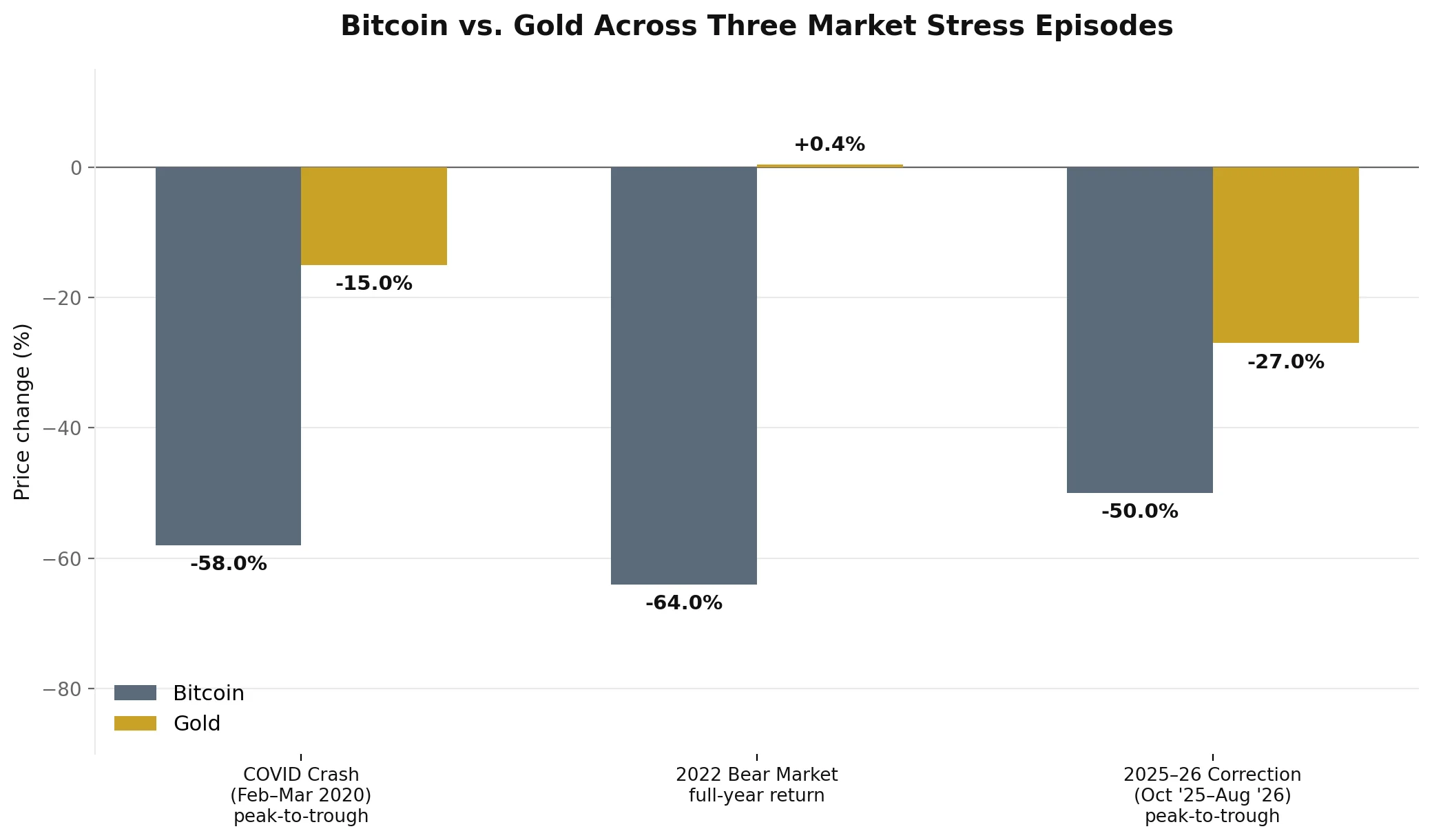
Bitcoin has fallen more than 50% at least three separate times since 2020 — gold has never had a comparable crash in that period.
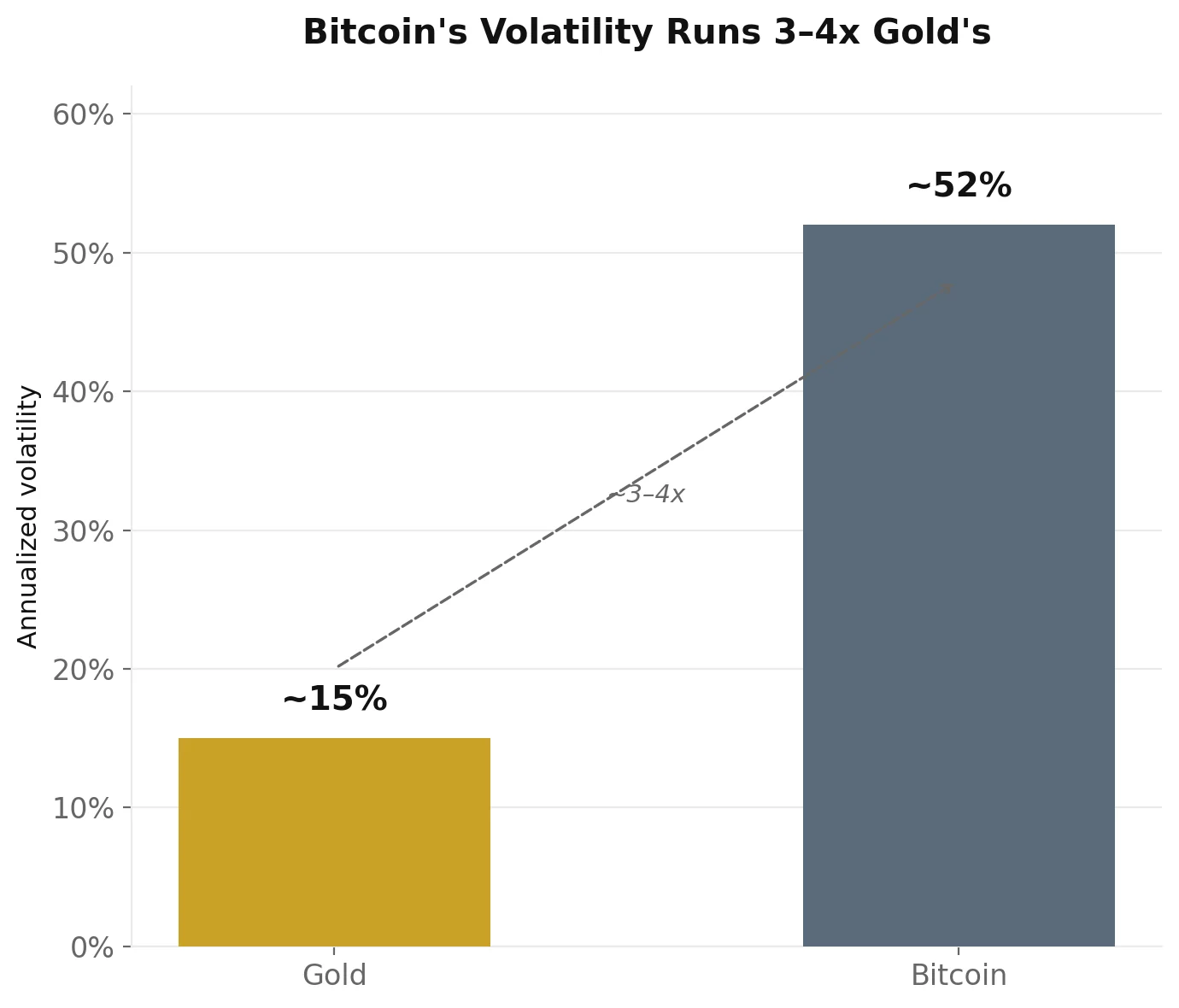
Bitcoin's annualized volatility (~52%) runs roughly 3 to 4 times gold's (~15%), a gap that has persisted for over a decade.
Gold's correlation to stocks has stayed near zero for decades. Bitcoin's correlation to stocks has risen substantially since 2020, especially after the 2024 Bitcoin ETF approvals — moving it closer to a risk asset than a hedge.
In every major stress episode tested below, gold either held its value or gained. Bitcoin fell hard in all three.
Test Case 1: The COVID Crash (February–March 2020)
When global markets seized up in March 2020, both assets sold off — this is the case skeptics point to when they say gold isn't really "safe" either. Bitcoin fell from around $9,100 to roughly $3,800 in a matter of days, a drop of about 58%. Gold also fell, from around $1,700 to near $1,450 — about 15% — as investors dumped every liquid asset they owned, gold included, to raise cash.
The difference showed up in the recovery. Gold rebounded and hit a new all-time high above $2,070/oz by August 2020, five months after the bottom. Bitcoin took until December 2020 just to reclaim its old 2017 high of $20,000 — a much longer round trip, and a far deeper hole to climb out of.
Test Case 2: The 2022 Bear Market
This is the cleanest test of the "digital gold" thesis, because 2022 was exactly the environment gold is supposed to struggle in: the Fed hiked rates at the fastest pace since the 1980s, real yields jumped 250 basis points, and the dollar surged more than 8%. Bitcoin, meanwhile, fell from its November 2021 peak of about $69,000 to roughly $16,600 by November 2022 — a 76% collapse, compounded by the collapse of FTX and several crypto lenders.
Gold, facing the same rate and dollar headwinds, finished 2022 up 0.4%. Not a rally — but not a crash either, in a year custom-built to punish it. If Bitcoin were truly a digital substitute for gold, this is the year it should have proven it. It did the opposite.
Test Case 3: The 2025–2026 Correction
This is the episode that opened this article. Bitcoin peaked at $126,198 in October 2025 and had fallen to around $64,000 by August 2026 — a 50% drawdown. Gold, over the same window, moved from about $4,366/oz to a fresh record of $5,589/oz in January 2026, before easing back to roughly $4,054/oz by August — a much smaller 27% pullback from its own peak, and still well above where it started the period.
Why the Gap Exists: Volatility and Correlation
The drawdown pattern isn't random. It traces back to two measurable properties.
Volatility. Bitcoin's annualized realized volatility has run around 50–54% in recent research from BlackRock's iShares and Fidelity Digital Assets, compared with roughly 15% for gold — a gap of 3 to 4 times. A more volatile asset doesn't just move more in both directions; over the same shock, it mechanically has further to fall.
Correlation to stocks. Gold's correlation to the S&P 500 has stayed close to zero for decades — it genuinely tends to move independently of equities, which is what makes it useful as a hedge. Bitcoin's correlation to the S&P 500 has risen over time, from close to zero in 2018–2020 to roughly 0.4–0.5 in the years following the January 2024 Bitcoin ETF approvals, as more institutional money began trading it alongside other risk assets. A "hedge" that increasingly moves with the thing it's supposed to hedge against is doing a different job than gold does.
So Is Bitcoin Just a Bad Version of Gold?
Not necessarily — it may simply be a different thing wearing gold's marketing. Bitcoin has delivered far larger long-run gains than gold and has real, distinct use cases (portability, programmability, a fixed and verifiable supply schedule). None of that is in dispute here. What the data above says is narrower: on the specific claim that Bitcoin behaves like gold — that it holds value and dampens portfolio risk during shocks — the last three major stress tests say it doesn't. It behaves like a high-beta risk asset that happens to also be scarce.
Frequently Asked Questions
Is Bitcoin actually "digital gold"? By marketing, yes. By behavior, not closely. Gold's defining trait as a portfolio asset is low, stable correlation to stocks and comparatively small drawdowns during crises. Bitcoin has neither, historically.
Why did gold barely move in 2022 when rates were rising fast — isn't that supposed to hurt gold too? It is, and it did create a headwind. But central banks bought a record amount of gold that year (over 1,000 tonnes, per the World Gold Council), offsetting the pressure from higher real yields. Bitcoin had no comparable offsetting buyer.
Does Bitcoin ever act like a hedge? At times, over short windows, yes — but its correlation to equities has trended upward since 2020, particularly after ETF approval brought in more institutional, risk-on capital. That's the opposite direction of what a reliable hedge should do.
Could this relationship change over time? Yes. Bitcoin's volatility has declined somewhat over the past decade as the market has matured, and its behavior could continue to shift. The comparisons above reflect the historical record through mid-2026, not a permanent law.
Should I own both? That depends on individual goals and risk tolerance, and isn't something this guide can answer for you — but the data suggests they play different portfolio roles rather than substituting for one another.
Key Conclusions
Bitcoin has fallen more than 50% in three separate episodes since 2020; gold has not had a comparable crash in any of them.
Gold recovered faster and further after the 2020 COVID crash than Bitcoin did.
In 2022 — the year that should have been gold's worst-case scenario — gold finished flat while Bitcoin fell 76%.
Bitcoin's volatility (~52% annualized) is 3–4 times gold's (~15%), a structural, long-running gap.
Gold's correlation to equities has stayed near zero; Bitcoin's has risen meaningfully since 2020, especially post-ETF approval.
The label "digital gold" describes Bitcoin's marketing, not its measured behavior against the asset it's named after.
Sources
- Bitcoin price history — public exchange data
- LBMA — gold price history
- World Gold Council — Gold Demand Trends
- BlackRock iShares — Bitcoin volatility research
- Fidelity Digital Assets — research
This article is provided for informational purposes only and does not constitute investment, financial, or trading advice.